A pennant pattern is a brief pause shaped like a small symmetrical triangle, which forms after a sharp price move. Like the flag, it is a continuation pattern: the market catches its breath before often moving on in the same direction.
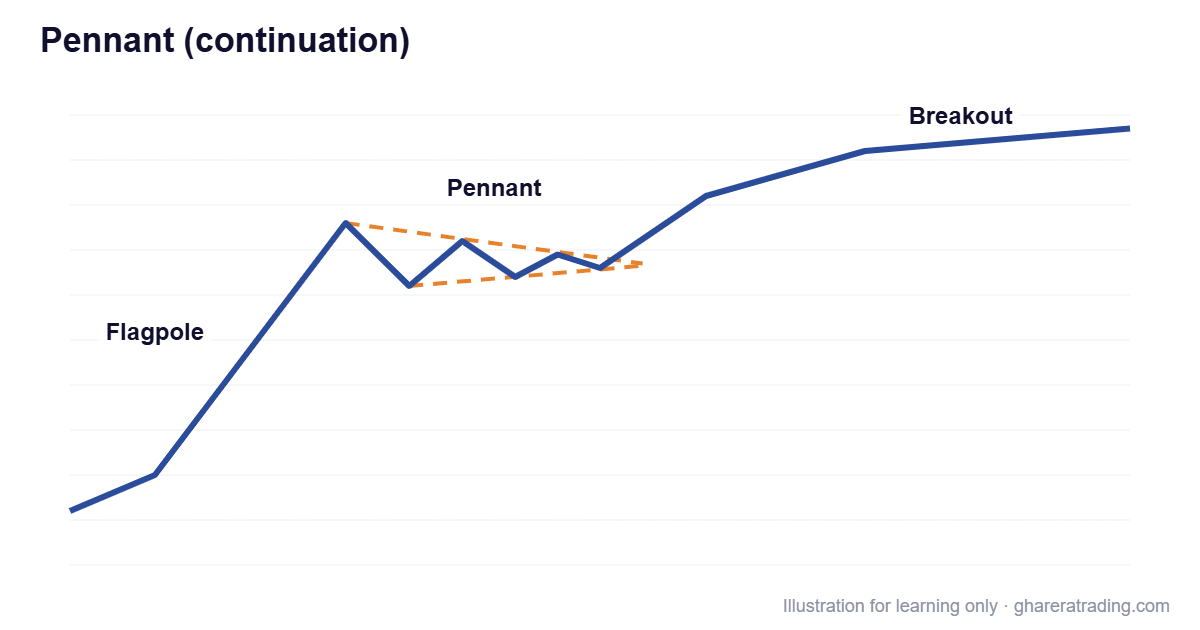
How a pennant forms
- A strong, fast move creates the flagpole.
- Price then trades in a small, narrowing range, with lower highs and higher lows, forming the pennant.
- A breakout from the pennant, usually in the direction of the flagpole, completes the pattern.
Bullish and bearish pennants
- Bullish pennant: forms after a sharp rise; traders watch for a break above the upper line.
- Bearish pennant: forms after a sharp fall; traders watch for a break below the lower line.
Pennant vs symmetrical triangle
Both have converging lines. The difference is size and context: a pennant is small and short-lived and comes straight after a strong flagpole, while a symmetrical triangle is larger and can form without a sharp move before it.
Key points beginners should know
- The pattern depends on a strong flagpole; without it, it is not a pennant.
- Volume usually fades inside the pennant and picks up on the breakout.
- Pennants can fail, so plan your stop loss before acting.
See also the flag pattern and our chart patterns guide.
Want to go beyond the basics?
This guide covers the basics of pennant patterns. Our technical analysis and trading course in Urdu takes you much further, with what this article leaves out:
- Complete trading strategies, with clear rules for entries, exits and stop losses
- Real chart examples, worked through step by step
- How to combine indicators, chart patterns and risk management into one plan
- Techniques you can apply to the Pakistan Stock Exchange, crypto, forex and other live markets
24 recorded lessons · about 11.5 hours · 12 months of access
This article is for education only and is not investment advice. Trading shares, cryptocurrencies, forex and other markets involves risk, including the loss of capital.